

Englisch Präsentation Vorlage 2026: PowerPoint Struktur ohne Übersetzen (für Business & Wissenschaft)
- Presentation School

- Apr 17
- 6 min read
Updated: Apr 27
English-First PowerPoint Template für deutsche Professionals - Stop Translating. Start Thinking in English.
Dieser Artikel ist auf Englisch geschrieben und zeigt dir den direkten Weg zu klaren Präsentationen - ohne lästiges Übersetzen.
Diese Englisch-Präsentation-Vorlage hilft dir, deine Präsentation von Anfang an klar auf Englisch zu strukturieren - statt sie später aus dem Deutschen zu übersetzen.
Last week, a research professional came to see me. She is highly skilled in her field and hopes one day to move into academia, presenting at international conferences, pitching for funding, and defending her work in English.
She told me, “I prepare everything in German first, then I translate. But the moment I stand up, my belly tightens, my breathing changes, and my mind goes blank. I freeze.”

This story is incredibly common among German professionals: researchers, engineers, consultants, and managers, who must present in English. The real problem is rarely vocabulary or grammar. The real problem is that they are still building the presentation in the wrong language for the performance.
Even when the structure is technically correct, it often breaks down under pressure. Because clarity is not just about structure on slides, but about how that structure is accessed in real time. (Read: English Presentation Structure article)
Most German professionals open PowerPoint immediately, think and write in German, create the full structure in their mother tongue, and only then begin translating slide by slide. It feels logical. It feels safe. But under pressure, translation breaks down. Sentences become longer, transitions feel forced, and precision disappears.
The better way, and the way I personally work, is to keep PowerPoint as the very last step.
First, collect all your ideas on paper, a whiteboard, or a simple document. Then build the storyline and structure in English while the ideas are still free from slide constraints. Only when the logic, flow, and key messages feel clear and natural in English do you open PowerPoint and turn that storyline into slides.
This small change alone dramatically reduces the translation tax and protects your English thinking.
The Communication Triangle

But there is an even deeper layer that almost no one teaches: an English-first template only works when you also understand the Communication Triangle: the three interconnected layers that determine whether your message actually lands under pressure.
The Communication Triangle consists of three core elements that must work together:
Physiology (your nervous system): This is what your body is doing in the moment: your breathing, posture, muscle tension, heart rate, and overall physical state. It speaks first, often before you say a single word.
Psychology (your internal state): Who you believe you are in the moment, your role, your identity, and the quiet story you tell yourself about the situation. This layer determines whether you freeze under pressure or flow with clarity.
Physicality (the signal the room reads): What the audience actually sees and senses: how you stand, move, pause, make eye contact, and use your voice. This is the visible expression of your internal state.
When these three layers are aligned, even a technical and difficult presentation feels steady and convincing. When they are out of alignment, even brilliant content can feel hesitant, strained, or unconvincing, no matter how well you prepared the slides.
The template below is designed to help you build the presentation in English while actively supporting all three sides of the Communication Triangle.
Before vs After Example
Before (Typical Translation Approach):
A researcher prepares her slides entirely in German. She writes detailed bullet points, builds the logic in her native language, then translates everything. When she presents in English, the sentences feel clunky, and she hesitates on transitions.
As soon as questions arise, her mind goes blank because she is still mentally translating in real time. The audience senses the internal effort. The impact weakens, and with it, the speaker’s confidence and credibility can suffer.

After (Direct English Thinking + Communication Triangle):
She first brainstorms on paper in English. She builds the storyline and key messages directly in English. Only then does she open PowerPoint and drop the content into the template. Before presenting, she runs the 60-second Identity Cue.
During delivery, she stays aware of her breathing and posture. The result? Clearer flow, no sudden blanks, and the audience stays engaged, because the message finally feels like hers, not a translated version of her.
Englisch Präsentation Vorlage (PowerPoint Template: 8–12 Slides)
This template is built specifically for German and non-native English speakers in research, academia, consulting, and technical roles across Germany. It keeps cognitive load low, gives you flexible openings, and ends with strength instead of a weak “Thank You”.
Recommended slide count: 8-12 (short and focused: the brain can only carry so much under pressure).


Title / Opening Slide (Prime real estate; do not waste it)
- Benefit-oriented or intriguing English title
- Your name + role + institution (small)
- One strong, relevant visual
Triangle check: Stand grounded, take one full breath, remind yourself, “I am the expert on this data.”
Agenda / What You Will Cover
-3–5 bullet points in parallel English structure
Triangle check: Gives the audience immediate orientation.
The Problem / Current Situation
- One clear gap or challenge
- Max 3–4 lines + one visual/data point
Why It Matters (The Bridge)
- Academic or practical impact (funding, publication, real-world application)
The Solution / Your Approach
- Your method or key findings — one main idea per slide
Key Results / Benefits
- Quantified outcomes or implications
Implementation / Next Steps
- Timeline, what happens next, what is needed
Summary / Key Takeaways
- 3 memorable points
Call to Action + Q&A (Strong Close)
- Clearly state what you want from the audience; what should they do, decide, or take away?
- Never close with “Thank You”.
Your final words are the ones that stay with people.


“Thank you” gives them nothing to act on.
A crisp, purposeful Call to Action turns your presentation into a decision or next step.
Flexible Opening Styles (choose based on the situation):
Direct Opening: “Today I’d like to walk you through the results of our recent analysis…”
Question Opening: “What would happen if our current approach no longer worked next year?”


Statistic Opening: “Over the past twelve months, our key metric has increased by 17 percent…”
Story Opening: “Last quarter, one of our largest collaborators told us something interesting…”
How to Use This Template (My Personal Process)
Collect ideas freely on paper or a blank document; No PowerPoint yet.
Build the storyline in English while the ideas are still fluid.
Only then open PowerPoint and turn the English storyline into slides using the template above.
Before rehearsing, run the 60-second Identity Cue: Name the moment → Choose your role → Set the standard → Choose your first action.
Practise speaking from the structure and check the Communication Triangle (physiology, psychology, physicality).

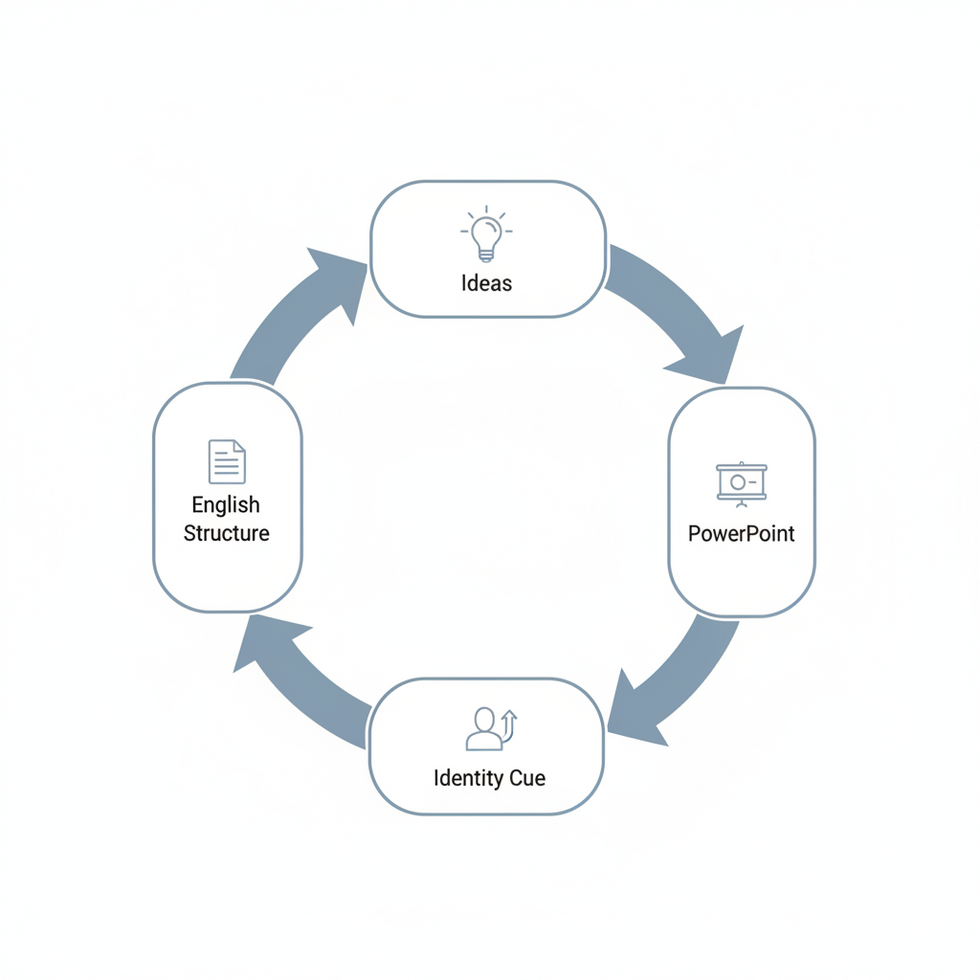
This process: Ideas first, English storyline second, PowerPoint last, is what separates good English presentations from great ones for non-native speakers.
Ready to Download the Actual Template?
I have prepared a clean, professional English-first PowerPoint template designed specifically for German and non-native English speakers. It includes flexible opening options, Triangle check reminders, speaker note guidance, and strong closing frames.
FAQs - Englisch Präsentation Vorlage
Sollte ich meine Präsentation zuerst auf Deutsch schreiben und dann übersetzen?
Nein. Das ist der häufigste Fehler. Übersetzen unter Druck funktioniert selten gut. Besser ist es, die gesamte Struktur und Storyline direkt auf Englisch aufzubauen.
Wie viele Folien sollte eine gute Englisch-Präsentation haben?
Ideal sind 8-12 Folien. Weniger ist meist besser - vor allem bei nicht-muttersprachlichen Sprechern.
Was ist der Communication Triangle?
Der Communication Triangle besteht aus drei Schichten: Physiology (Körper & Nervensystem), Psychology (Rolle & innere Haltung) und Physicality (das Signal, das das Publikum sieht). Wenn diese drei zusammenarbeiten, wirkt die Präsentation ruhig und überzeugend.
Funktioniert diese Vorlage auch für wissenschaftliche Präsentationen?
Ja. Die Vorlage ist bewusst für Forscher, Ingenieure und Akademiker entwickelt worden und eignet sich besonders gut für Fachvorträge und Funding-Pitches.
Muss ich am Ende "Thank You“ sagen?
Nein. „Thank You“ ist ein schwacher Abschluss. Besser ist ein klarer Call to Action, der dem Publikum zeigt, was als Nächstes passiert.
Final Thoughts
A great English presentation is not about fancy design. It is about forcing yourself to think and structure in the language you will actually perform in, while keeping your Communication Triangle aligned.
When you collect ideas first, build the storyline in English, and only then move into PowerPoint, you stop fighting translation under pressure. Your ideas finally belong to the English version instead of feeling like a borrowed translation of you.
Want to go deeper?
Learn more about building Executive Presence in English presentations - how to project authority and stay steady even when English is not your first language.
Stop translating. Start building directly in English.
Your ideas deserve to land with the same clarity and confidence in English as they do in German, and now you have the exact tool (and framework) to make that happen.
Kunle Orankan
Founder, Presentation School Berlin


Comments