

Executive Presence für deutsche Führungskräfte: Warum starke Inhalte allein nicht reichen

The Missing Link Between Technical Excellence and Real Influence
Dieser Executive-Prezence-Artikel ist auf Englisch geschrieben, weil die meisten deutschen Führungskräfte heute in internationalen und englischsprachigen Umgebungen arbeiten. So kannst du die Konzepte direkt in der Sprache aufnehmen, in der du sie anwendest, ohne den Umweg über eine Übersetzung.
Executive Presence can look very different from one person to another. Consider Steve Jobs in his black turtleneck and jeans. Look at Mark Zuckerberg in his signature hoodie. Think of Christian Klein, CEO of SAP, in a perfectly tailored suit.
Or watch Ursula von der Leyen, President of the European Commission, commanding rooms full of world leaders in English. They dress, move, and speak in completely different ways. Yet the moment any of them step into a room, people listen, and action follows.
On the surface, their Executive Presence looks nothing alike. So what do they actually share?

The Common Misconception - A Systemic, Not Individual Problem
Many high-performing professionals (engineers, accountants, lawyers, consultants, researchers, managers) believe the same thing: “If my craft is excellent and I deliver strong results, presence will follow, and I will be noticed and promoted.”
This belief is understandable. Our entire education and career path is built around deep specialization: university degrees, certifications, technical mastery, flawless execution. But almost no one teaches Executive Presence.

Especially during the critical transition from “good professional who executes well” to roles that require facing executives, making executive decisions, or appearing at the executive level.
Because of this missing education, Gravitas, Communication, and Appearance are naturally absent for most people. It is not an intelligence issue or an individual failing. It is a widespread, structural gap. Many professionals never successfully cross this invisible transition line.

The Real Story - A High-Performing Professional Stuck in the Transition
A few weeks ago, I spoke with a highly competent professional (let’s call her Laura). She consistently over-delivers and does a smashing job in her role. She receives excellent feedback on her craft and actual work output.
Yet she has been passed over for promotion to VP-level roles multiple times. The reason is not a lack of intelligence or poor performance. Laura is the kind of professional who elevates any team she joins: technically brilliant, highly reliable, and consistently over-delivering.
Yet she is literally missing the three components of Executive Presence: she has no Gravitas in the room, she struggles to communicate her value effectively, and her appearance is “zero” - she does not carry or own her look in the room.
She knows her material perfectly and executes at a high level, but she cannot translate that excellence into visible influence at the next level. Unfortunately, this is not an isolated case. It is the generic problem most professionals face during this transition.
What Executive Presence Actually Is (Executive Presence für Deutsche Führungskräfte)
Sylvia Ann Hewlett, one of the leading authorities on the subject, identified three core components of Executive Presence: Appearance, Communication, and Gravitas.

Appearance
It is not about breaking the bank on designer clothes or forcing a suit-and-tie look. Steve Jobs wore the same black turtleneck and jeans for decades and owned it completely.
Appearance is about owning and carrying whatever style you choose with comfort, freshness, and congruence. What you wear (and how you carry it) has a direct psychological impact on your own confidence, posture, and internal state.
Communication
The successful, deliberate transfer of meaning from you (point A) to the audience (point B) that drives a desired outcome - whether to inform, entertain, or move people to action. It is not just speaking clearly; it is making sure the message lands and creates the intended result.
Gravitas
Gravitas is the quiet weight and credibility that makes people listen and take you seriously, even before you finish your first sentence. It is the inner authority that says, “This person is worth following.”

It shows up as calm confidence under pressure, decisiveness in ambiguity, and the ability to hold the room without raising your voice.
The Deeper Layer - Our Communication Triangle
These components are not random. They are the visible result of something deeper and trainable: the Communication Triangle - the framework I developed and explain in detail in my book Before You Speak.
At its core, the Communication Triangle shows that true Executive Presence is not a personality trait or surface-level performance. It is the result of three interconnected layers working together under pressure:
Physiology - How well your nervous system stays regulated when the stakes are high. This is the foundation: calm breathing, steady heart rate, and a body that doesn’t default to fight-or-flight mode.
Psychology - The identity and role you consciously choose to hold in the moment. This determines whether you show up as someone who proves correctness or as someone who leads clarity and forward movement.

Physicality - The visible signal the room actually reads through your posture, voice, pacing, eye contact, and presence. This is what others experience before they fully process your words.
When these three layers are aligned, Gravitas, clear Communication, and authentic appearance emerge naturally, regardless of your personal style, industry, or outfit.
The Triangle turns Executive Presence from something mysterious into something practical and trainable.
Diagnosis Is Half the Cure - Simple Self-Assessment
As the saying goes, diagnosis is half the cure. Most professionals never even know exactly where their Executive Presence gap is.
Take 60 seconds right now and ask yourself these five questions:

When I speak in high-stakes situations, do people lean in and listen naturally, or do I feel I have to work hard to hold their attention?
Do I feel I own my appearance and carry it with comfort and confidence?
Can I transfer my ideas so the audience immediately understands the intended outcome?
In high-pressure moments, do I default to proving correctness or to leading clarity and forward movement?
When I leave a meeting or presentation, do people remember the decision or the person who led it?
Be honest with yourself. Most professionals are strong in one or two areas and weak in the third. The good news: the weak link is trainable.
The Practical 60-Second System You Can Use Tomorrow
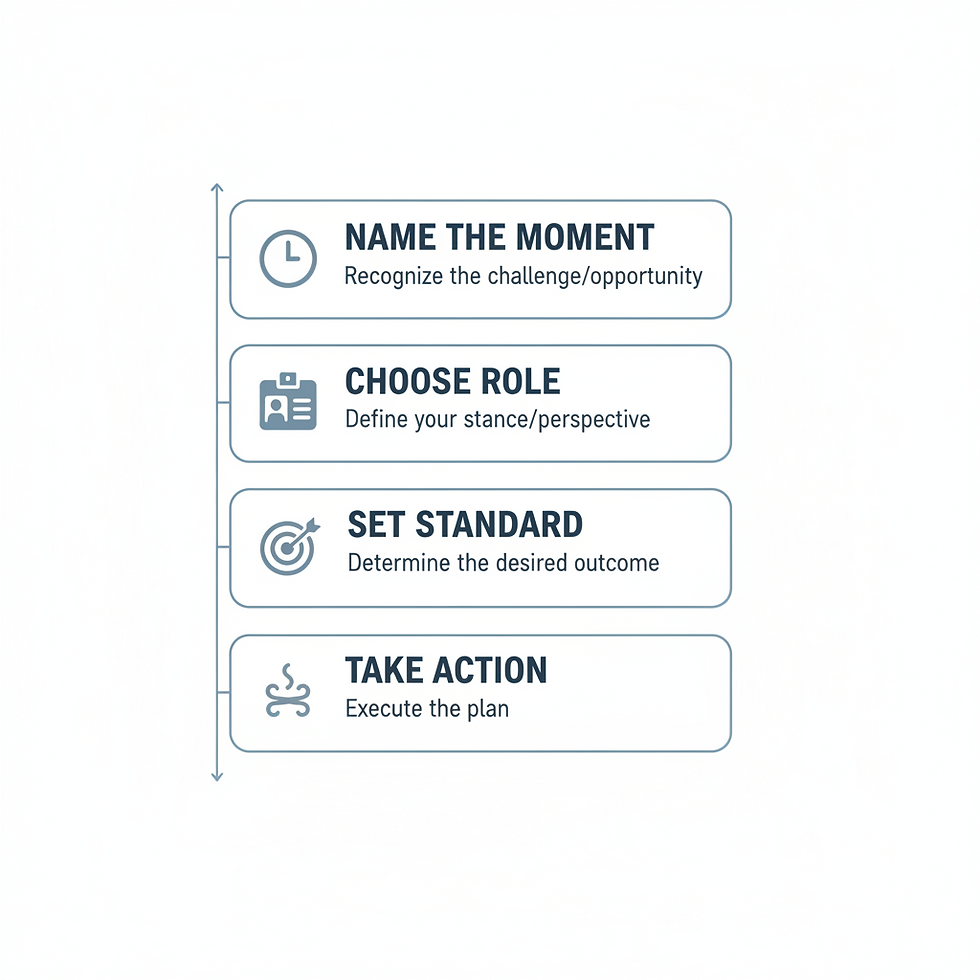
The 60-Second Identity Cue (Before Any High-Stakes Moment)
Name the moment: “This is the moment where clarity and direction are needed.
Choose your role: “My role is to lead with calm confidence and move things forward.”
Set the standard: “I speak from clear intention, not from the need to sound perfect.”
Take the first action: “One full breath + stand grounded.”
A Personal Note on Deliberate Practice
I have run five kilometres two or three times a week for more than fifteen years. For most of that time, I finished in almost exactly thirty minutes. No matter how consistently I ran, my timing never improved.

Then I read Angela Duckworth’s Grit and the research on deliberate practice. I started measuring and focusing on one specific aspect -my pace on the final kilometre. Within weeks, my best time dropped below twenty-four minutes.
The moment I stopped the deliberate focus and measurement, I slipped back into my old habits.
Executive Presence works the same way. Mere repetition is not enough. You need deliberate, measured practice on one component at a time, and most people benefit greatly from structure and support to stay consistent.
Your Long-Term Plan
You didn’t become excellent at your craft by attending one class or reading one article. You followed a curriculum and practised deliberately over time. Build Executive Presence the same way:
Choose one component of the Communication Triangle to focus on each quarter.
Measure progress every month with the five-question self-assessment.
Use the 60-second Identity Cue before every high-stakes interaction.
As James Clear writes in Atomic Habits, small, consistent actions compound. Professionals who invest in this way finally cross the transition line that many never manage to cross.
Their existing excellence becomes clearly visible. And they get noticed, trusted, and promoted for the leadership roles they are already capable of. This can be you and your story.
Learn more about building Executive Presence - how to project authority and stay steady even in high-stakes environments.
FAQs - Häufige Fragen zu Executive Presence
Was ist Executive Presence genau?
Executive Presence ist die Fähigkeit, unter Druck Klarheit, Souveränität und Autorität auszustrahlen, unabhängig von persönlichem Stil oder Branche.
Kann man Executive Presence lernen?
Ja. Es ist kein angeborenes Talent, sondern ein erlernbares Skill-Set, das auf dem Communication Triangle basiert.
Warum fehlt vielen starken Fachkräften Executive Presence?
Unser Ausbildungssystem fokussiert sich auf fachliche Kompetenz und Kommunikation sowie Souveränität. Hierbei ist eine Lücke im System.
Wie lange dauert es, Executive Presence aufzubauen?
Die ersten spürbaren Veränderungen kommen schon nach wenigen Wochen bewusster Übung. Der Feinschliff entsteht durch konsequentes, vierteljährliches Training einer Komponente nach der anderen.


Comments